
School and Volunteer Coordination Statistics (U.S.)
A curated U.S. statistics hub for school volunteer planning, PTO and PTA coordination, parent involvement, digital access, and nonprofit volunteer operations. Sourced from AmeriCorps, NCES, Pew Research Center, and top-tier nonprofit research.
Want a privacy-first sign-up tool?
No ads on public boards, minimal guest friction, and a cleaner coordination flow for schools and community groups.
Editors, school resource managers, PTO and PTA organizers, nonprofit volunteer teams, and comparison-page authors
Informational and editorial citation intent around school and volunteer coordination statistics
School and PTA resource placements, volunteer or nonprofit resource placements, privacy and trust resource pages, and comparison-page supporting citations
Best fit for
Not ideal when
This page is a curated U.S. statistics hub for school and volunteer coordination. It pulls together relevant numbers from government research, academic and university-backed research, and top-tier nonprofit-sector reports.
It is not original GatherTasks research. The goal is simpler than that: give school organizers, PTO and PTA leaders, volunteer coordinators, and editors one page they can cite when they need credible context for how much coordination work still happens, how families access digital tools, and where volunteer-management pressure shows up in practice.
Key Findings
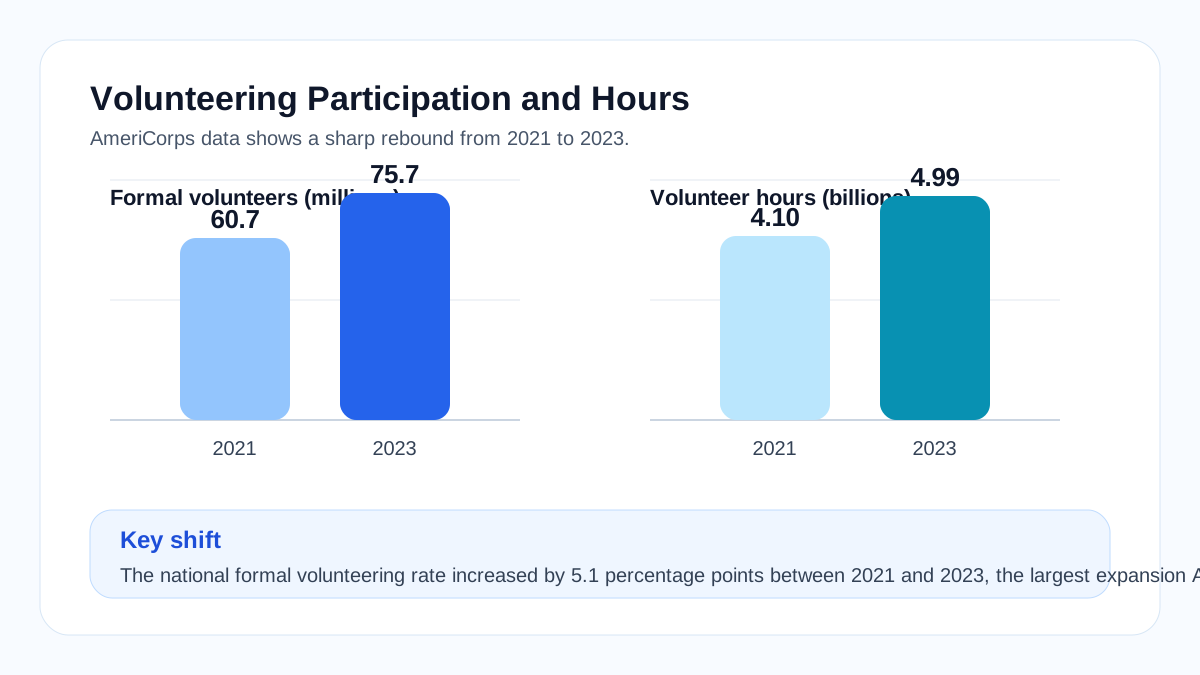
- More than 75.7 million Americans formally volunteered through an organization in 2023, equal to a 28.3% formal volunteering rate. Source: AmeriCorps, Volunteering and Civic Life in America
- Those volunteers contributed 4.99 billion hours with an estimated $167.2 billion in economic value. Source: AmeriCorps research summary
- More than 54% of Americans, or 137.5 million people, informally helped neighbors between 2022 and 2023. Source: AmeriCorps blog summary of the 2024 release
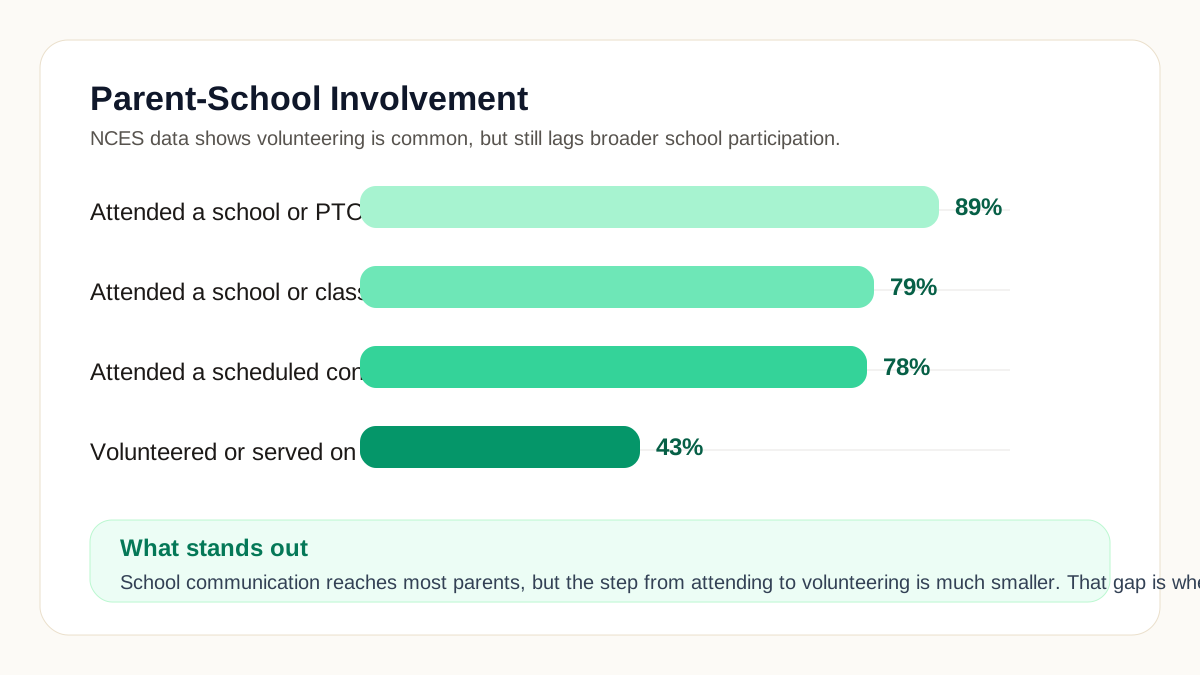
- In federal school-involvement data, 43% of parents said they volunteered or served on a school committee. Source: NCES Parent and Family Involvement in Education, 2016
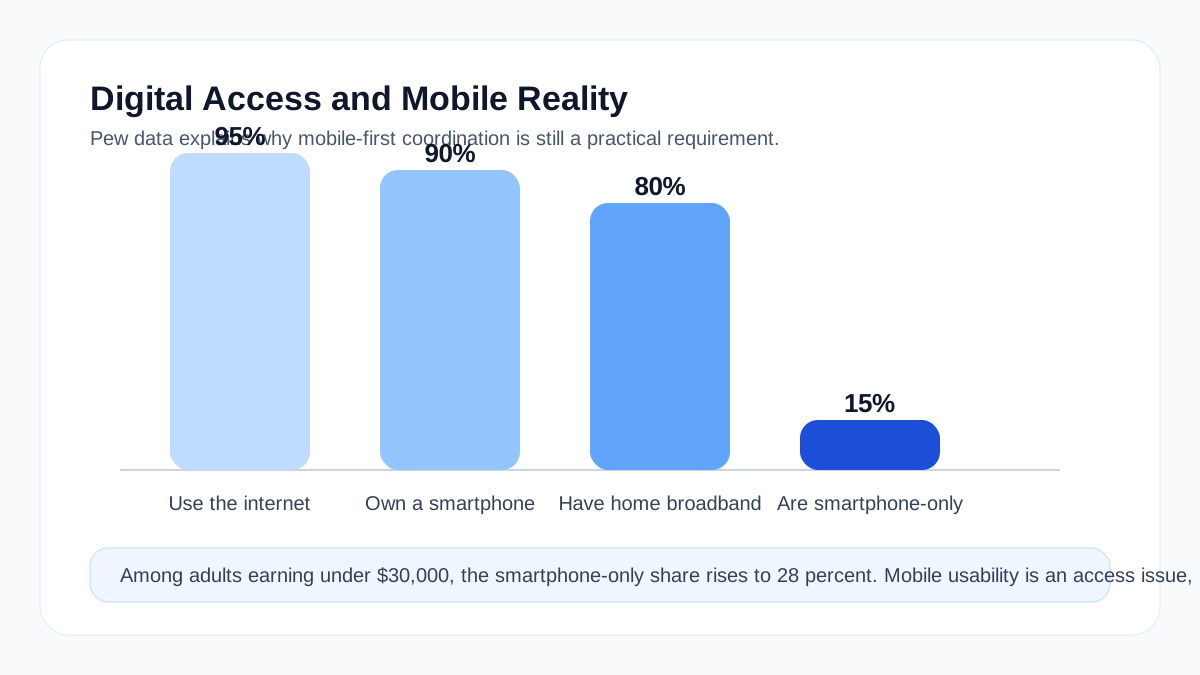
- 90% of U.S. adults own a smartphone, but 15% are still smartphone-only internet users and 28% of adults earning under $30,000 fall into that group. Source: Pew Research Center mobile technology and broadband, 2024 and Pew smartphone dependence, 2024
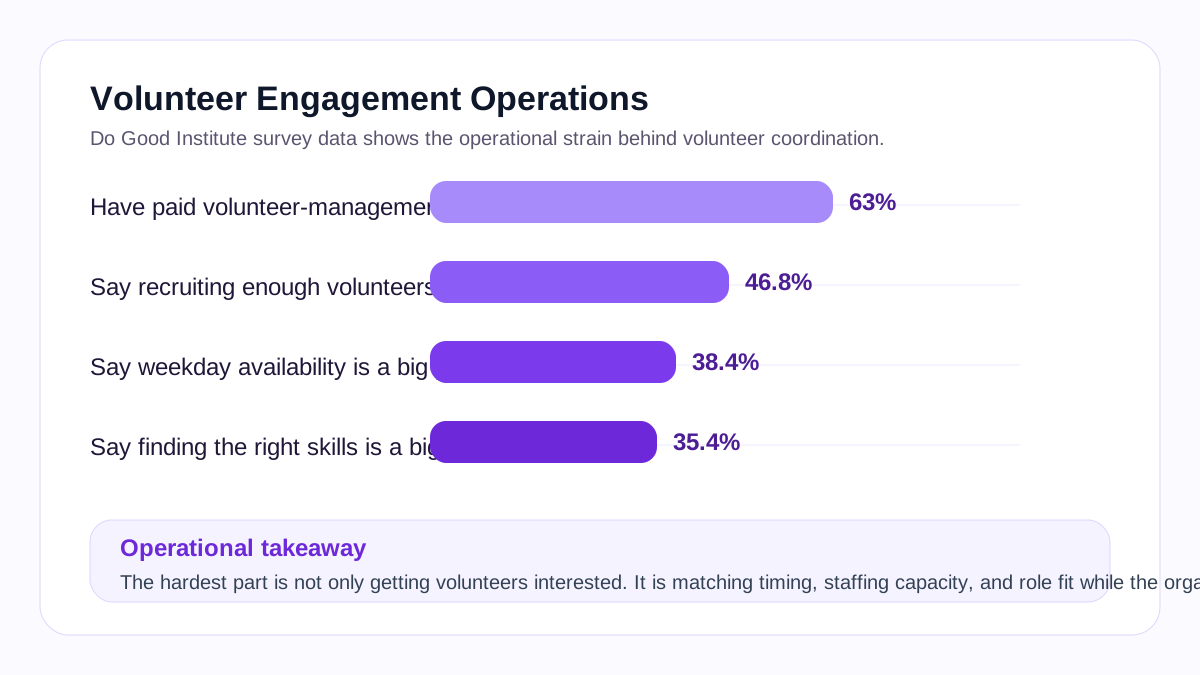
- Among nonprofits that involve volunteers, 63% have a paid staff member managing volunteer engagement. Source: Do Good Institute, The State of Volunteer Engagement
- 46.8% of nonprofit CEOs say recruiting enough volunteers is a big problem, while 38.4% say weekday availability is a big problem. Source: Do Good Institute report
- 64.4% of nonprofits reported increased demand for services in 2022, even while many were involving fewer volunteers than before the pandemic. Source: Do Good Institute report
Volunteering in the U.S.
Volunteer coordination is not a small niche workflow. Nationally, formal volunteering alone still involves tens of millions of people, billions of hours, and a large amount of social and economic value. For organizers, that means the coordination layer matters. A school sign-up sheet or a volunteer board is not administrative fluff. It is part of how real participation gets organized.
| Volunteering statistic | Latest figure | Why it matters for coordination | Source |
|---|---|---|---|
| Americans who formally volunteered through an organization in 2023 | 75.7 million | Sign-up and coordination workflows still affect a huge audience | AmeriCorps |
| National formal volunteering rate in 2023 | 28.3% | Participation is broad enough that mainstream school and community workflows matter | AmeriCorps |
| Volunteer hours contributed in 2023 | 4.99 billion | Billions of hours means small workflow improvements compound quickly | AmeriCorps |
| Estimated economic value of formal volunteer hours in 2023 | $167.2 billion | Volunteer coordination has measurable real-world value, not just goodwill value | AmeriCorps |
| Growth in the national formal volunteering rate from 2021 to 2023 | +5.1 percentage points | Participation rebounded, which raises the importance of scalable coordination | AmeriCorps press release, Nov. 19, 2024 |
| Growth rate of formal volunteering in just two years | More than 22% | Organizers may be serving a more active volunteer base than they were in 2021 | AmeriCorps press release |
| Americans who informally helped neighbors between 2022 and 2023 | 137.5 million | A large share of coordination still happens outside formal programs | AmeriCorps blog summary |
| Share of Americans who informally helped neighbors | More than 54% | Community support is broader than formal volunteering alone | AmeriCorps blog summary |
School and Parent Involvement
Official school-volunteering data is not updated as often as many organizers would like, so the best clean federal source here is still NCES parent-involvement reporting. It is older than the digital-access data on this page, but it remains useful because it measures exactly the kinds of actions school organizers care about: meetings, events, volunteering, and committee service.
| School and parent involvement statistic | Figure | Why it matters for coordination | Source |
|---|---|---|---|
| Parents who attended a general school or PTO meeting | 89% | Meeting attendance is common, so outreach can start from existing school-touchpoint behavior | NCES, Parent and Family Involvement in Education |
| Parents who attended a school or class event | 79% | Event participation is high enough that school sign-up workflows matter for large groups | NCES |
| Parents who attended a scheduled parent-teacher conference | 78% | Families already respond to structured school asks when the process is clear | NCES |
| Parents who volunteered or served on a school committee | 43% | Volunteer coordination is a real school workflow, not a fringe one | NCES |
| K-2 parents who volunteered or served on a school committee | 56% | Early grades can support deeper volunteer asks | NCES |
| Grades 9-12 parents who volunteered or served on a school committee | 32% | Volunteer expectations and response rates can vary sharply by school level | NCES |
| Poor families who volunteered or served | 27% | Schools should expect participation barriers, not just motivation differences | NCES |
| Nonpoor families who volunteered or served | 47% | Participation gaps affect how roles should be structured and communicated | NCES |
Digital Access and Mobile Reality
If a sign-up workflow is awkward on mobile, it will miss people. That is not a design preference issue. It is an access issue. U.S. digital access is broad, but not uniform. Some adults rely on smartphones as their main way online, and that reality shows up more heavily in lower-income households and among people with less formal education.
| Digital access statistic | Figure | Why it matters for coordination | Source |
|---|---|---|---|
| U.S. adults who use the internet | 95% | Digital coordination reaches most adults, but not everyone | Pew Research Center, June 2024 |
| U.S. adults who own a smartphone | 90% | Most parents and volunteers will open links on phones at least some of the time | Pew Research Center, June 2024 |
| U.S. adults with home broadband | 80% | A phone-first experience still matters because broadband is not universal | Pew Research Center, June 2024 |
| Rural adults with home broadband | 73% | Rural communities may face tighter access constraints than national averages suggest | Pew Research Center, June 2024 |
| U.S. adults who are smartphone-only internet users | 15% | Some participants depend on phones instead of a home broadband setup | Pew Research Center, Jan. 2024 |
| Adults earning under $30,000 who are smartphone-only | 28% | Lower-income families are more likely to be pushed into phone-only participation | Pew Research Center, Jan. 2024 |
| Adults with a high school diploma or less who are smartphone-only | 24% | Mobile-first design has equity implications, not just convenience implications | Pew Research Center, Jan. 2024 |
| Smartphone-only adults who say they are online almost constantly | 41% | Phone-dependent users are active online, but often in a constrained format | Pew Research Center, Jan. 2024 |
Volunteer Engagement Operations
Volunteer coordination pressure does not come only from participation volume. It also comes from staffing limits, recruiting difficulty, weekday availability, and the fact that many nonprofits are serving more people with stretched teams. The strongest operational source here is the Do Good Institute's 2022 survey of 1,210 nonprofit leaders, published in 2023 with support from the Initiative for Strategic Volunteer Engagement and shared by Independent Sector.
| Volunteer engagement operations statistic | Figure | Why it matters for coordination | Source |
|---|---|---|---|
| Nonprofits that involve volunteers and have a paid staff member or volunteer engagement professional managing them | 63% | Volunteer coordination often needs real staff time, not just goodwill | Do Good Institute report |
| Nonprofits reporting increased demand for services | 64.4% | Coordination pressure rose while organizations were already stretched | Do Good Institute report |
| Nonprofits increasing delivery of services and goods | 51.0% | More services means more staffing and volunteer logistics to coordinate | Do Good Institute report |
| Nonprofits reporting increased staff workloads | 48.5% | Heavy manual coordination competes with other staff priorities | Do Good Institute report |
| CEOs saying recruiting enough volunteers is a big problem | 46.8% | Recruiting remains the clearest operational bottleneck | Do Good Institute report |
| CEOs saying weekday availability is a big problem | 38.4% | Scheduling, not just willingness, blocks volunteer coverage | Do Good Institute report |
| CEOs saying finding volunteers with the right skills is a big problem | 35.4% | Role design and volunteer-role clarity matter when skills are uneven | Do Good Institute report |
| CEOs saying volunteers increase return on resource investments to a great extent | 68.4% | Better volunteer coordination can affect operating efficiency, not just participation totals | Do Good Institute report |
What These Stats Mean for Organizers
These numbers do not say that every school or nonprofit needs the same tool. They do point to a few practical realities:
- Volunteer coordination is mainstream work. Tens of millions of people still volunteer formally, and millions more help informally. That makes coordination quality a real operational concern.
- School engagement is broad, but volunteering is still a narrower action than attending. Families show up for meetings and events at much higher rates than they volunteer. That means schools should make volunteer asks clearer, smaller, and easier to complete.
- Mobile access is non-negotiable. A meaningful share of adults are phone-dependent or phone-first. If a sign-up experience is hard to scan or complete on a phone, some families and volunteers will feel that friction more than others.
- Nonprofit coordination pain is operational, not theoretical. Staff time, recruiting shortages, weekday availability, and skills mismatches all show up in the data.
- One clear ask beats one complicated workflow. The more an organizer can reduce ambiguity around what is needed, when it is needed, and how to claim it, the better the odds of coverage.
Methodology and Source Notes
This page is intentionally limited to U.S.-relevant research that directly informs school or volunteer coordination. It is not a generic nonprofit-statistics roundup and it is not original GatherTasks research.
Source-selection rules for this page:
- Primary and top-tier only. Government research, Pew Research Center, and university or top-tier nonprofit-sector research with a clear methodology.
- Coordination relevance required. Stats had to relate to participation, school involvement, digital access, or volunteer-management operations.
- No vendor SEO studies. Marketing surveys, generic tool roundups, and weakly sourced conversion claims were excluded.
- U.S. only in v1. The page is scoped for U.S.-based school, PTA, PTO, and volunteer resource use.
Important caveats:
- The school-involvement section leans on the best clean federal NCES source available for parent volunteering and committee participation, but that source is older than the AmeriCorps and Pew data.
- The nonprofit-operations section uses survey evidence from the Do Good Institute's 2022 nonprofit survey. Those numbers are useful for operational context, but they should be read as survey findings about nonprofit management realities, not as laws of nature that apply identically in every organization.
- AmeriCorps figures on volunteer hours and economic value are tied to the federal research release and the valuation methods used in that research cycle.
Source dates used on this page
- AmeriCorps Volunteering and Civic Life in America, current research page reflecting the November 2024 release
- AmeriCorps press release: More than 75.7 Million People Volunteered in America, November 19, 2024
- AmeriCorps press release: 60.7 Million Americans Volunteered in 2021, November 16, 2022
- NCES Parent and Family Involvement in Education: 2016, published 2017
- Pew Research Center: Mobile Technology and Home Broadband 2024, June 3, 2024
- Pew Research Center: Americans' Cellphone Dependence on Smartphones, January 31, 2024
- Pew Research Center: Americans' Smartphone Dependence Is Linked to Broader Digital Gaps, January 31, 2024
- Do Good Institute: The State of Volunteer Engagement, February 2023
Related GatherTasks Resources
- PTA / PTO Event Planning Hub
- Back to School Parent Volunteer Guide
- GatherTasks vs SignUpGenius
- Classroom Volunteer Schedule
- Field Trip Chaperone Sign Up
- Food Drive Volunteer Sign Up
Soft CTA
If you are turning these numbers into a real school workflow, start with the PTA / PTO Event Planning Hub or the Classroom Volunteer Schedule instead of rebuilding the process from scratch.
Ready to Try These Strategies?
Create your first task coordination board and see the difference organized planning makes.